
穆赫兰道
China's World Cup hopes begin with children taking the field. What's next?_我的网站

A |

It was a busy school break. The national finals of the 2025-26 youth campus soccer league, rounds of the fifth China Youth Football League, city and provincial campus competitions, private club cups and overseas invitationals filled the calendar. Some children played close to home; others spent part of their summer travelling with teammates from one tournament to another.
The sixth 2034 Cup was among the most visible. Its 39 regional qualifiers drew 882 teams and 12,604 players, with 128 teams reaching the finals in Suzhou, East China's Jiangsu Province. Teams from other countries also took part, adding an international element to a tournament aimed at primary-school players, according to the Xinhua News Agency.
Does this crowded calendar by itself signal a turnaround for Chinese soccer? China's men last reached the World Cup in 2002. But the summer offered a view of a playing base being built from below and raised a harder question: Can the enthusiasm survive the return to school, unequal access to training and the growing costs borne by families?
From the first touch
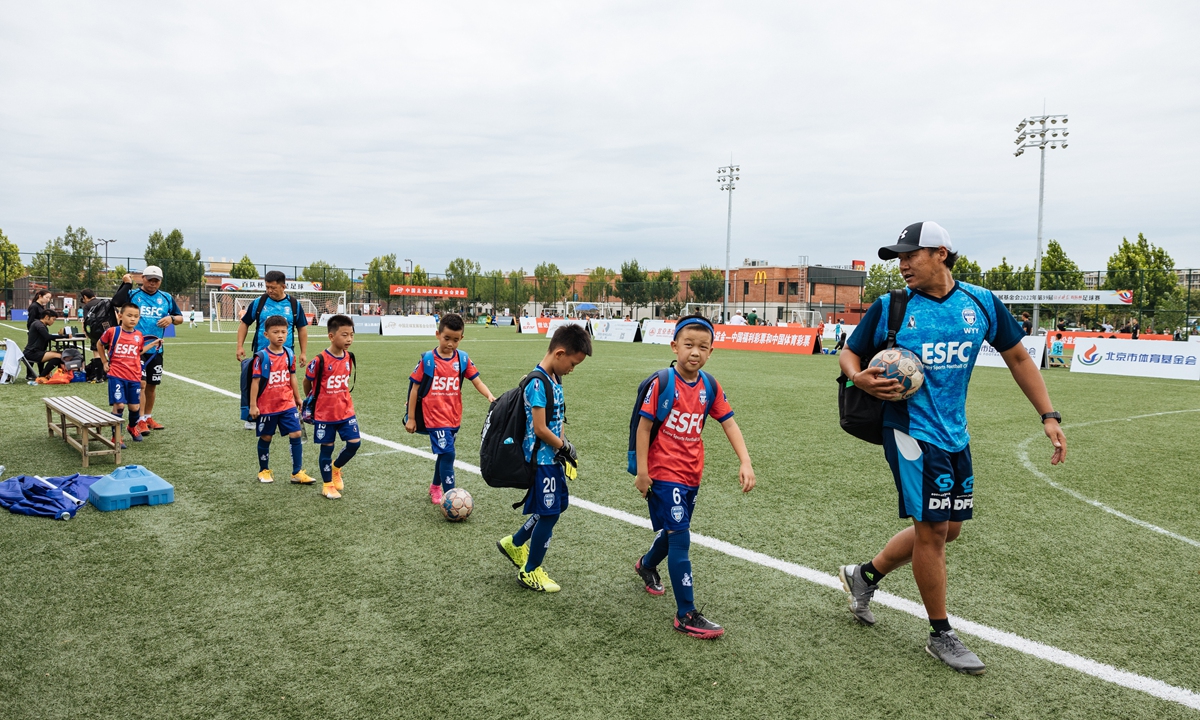
In China's youth soccer system, coach Zhao Xinxin works at its broadest and most fundamental level - introducing young children to the game.
He coaches an introductory group of about 15 three-year-olds, three interest classes of 15 to 20 children aged five to 10, and four advanced groups of roughly 10 players aged five to 14. He has worked with more than 100 children over the years.
Starting younger is one of the clearest changes Zhao has observed in recent years. Soccer is appearing not only in schools and social clubs but also in some kindergartens. Most parents initially want an after-school activity that gets their kid moving.
Only when a player begins to stand out do questions about more advanced training and a possible route forward arise.
That route now has several layers. A child in a commercial club can move from introductory and interest classes to advanced teams. A school player may be selected for district and city teams, then enter national campus competitions; professional academies, sports schools and social clubs provide other pathways.
China began promoting campus soccer on a national scale in 2015, when six government departments issued guidelines calling for soccer to be incorporated into school education through designated soccer schools, regular competitions, teacher training and improved facilities, according to the Ministry of Education.
The program has continued to expand while shifting its focus from increasing participation to improving the quality of teaching, training and competition. In 2025, another 4,928 schools were recognized as national youth campus soccer schools, according to the ministry.
The result is more soccer on the calendar. Zhao told the Global Times that youth matches take place somewhere in Beijing almost every week, especially during school holidays. His club's advanced teams play weekend fixtures with referees and standings, as well as regional competitions and finals.
Tournaments such as the 2034 Cup give this broad base a visible target. Soccer commentator and youth-project organizer Dong Lu launched the event in 2021 after repeatedly seeing Chinese social media celebrate Japan's high-school soccer tournament. Its name looks toward the 2034 World Cup, when the first group of participants will be about 25.
Earlier this summer, a team selected through Dong's youth soccer project offered another source of encouragement. The Chinese Football Boy U12 team won all seven matches at the Sigismondi International Youth Cup in Italy, becoming the first Asian team to claim the championship.
Yet Dong cautioned against reading too much into a single championship. Strong players, he said, must emerge from a much broader soccer culture. "Players come from the people around us, from the soil and culture in which they grow," he told the Global Times.
Who can keep playing?
For Zhao, the first major break comes at 12. Children may train throughout primary school, then stop after entering middle school as homework, examinations and family expectations take over - a pattern he calls "retiring at 12."
Campus soccer should be the main way to keep the player pool broad, he said, because school is where nearly every child spends most of the day. More schools now provide soccer classes and in-class competitions, but implementation varies.
Zhao recalled a class tournament in which a child was injured. After a parent complained, the remaining matches were cancelled. Safety concerns are understandable, he said, but cancelling competition altogether removes opportunities from every child.
For families, this is also the stage when soccer stops being a simple extracurricular activity. If a child has shown unusual ability, parents must decide whether to seek stronger teams, change schools, accept more travel and training, or keep soccer only as an interest. The decision depends not only on talent and the child's wishes, but also on educational expectations and how much time and money the household can commit.
The contrast with Europe lies partly in continuity. Zhao cited his nephew in Hungary, who trained at a Barcelona-affiliated academy between the ages of six and eight before being selected by a local club at nine.
Once children join organized training there, he said, they are registered at relatively low cost, and their movement between clubs is recorded in the soccer association's system - closer to transferring schools than simply leaving one commercial course for another.
Dong made a broader comparison. Japan's national team increasingly draws on players who have further developed further in European leagues, while China still relies mainly on its domestic league to prepare future internationals.
In his view, the two systems operate like production lines with different competitive standards. Young Chinese players therefore need more high-level matches, whether foreign teams come to China, Chinese teams travel abroad or selected players enter overseas leagues.
But overseas training cannot substitute for a domestic system, nor is it open to every family. Zhao said it requires ability, physical readiness, money and the capacity to adapt to a different language, diet and daily life. Some parents send a child abroad; others move with them, reorganizing work and family life around soccer without knowing whether the child will ever turn professional.
For now, the most telling test may come not in 2034, but this coming September, when a child enters a new grade and decides whether there is still time in the week for soccer.
。

B | The U.S. Food and Drug Administration has issued a notice suggesting it may consider a proposal to ban the use of formaldehyde in hair straightening and hair smoothing products.The FDA's consideration of the proposal was entered in the Unified Agenda, a government registry of actions that administrative agencies plan to issue.There is no set timeline on when the agency may consider the proposal or when, if it moves forward, a ban would go into effect.Frequent use of hair-straightening products that include chemicals like formaldehyde has been found in studies to put women at a higher risk for uterine cancer.One study published last year found an association that women who self-reported frequent use of hair straightening products were more than twice as likely to later develop uterine cancer than women who did not use the products. Scientists caution that it's not clear yet if these products cause cancer. For now, research only hints at only a probable link.Uterine cancer, a type of cancer that starts in the uterus, is a risk factor for anyone with a uterus, but the risk increases with age, especially during and after menopause, according to the Centers for Disease Control and Prevention.Last year's study found that Black women may be more affected by the increased risk of uterine cancer not because of their race, but due to the fact that they use chemical hair straightening products at a higher rate. Frequent use of the products was defined as more than four times in the previous year, according to the study, which included more than 33,000 women between the ages of 35 to 74.Formaldehyde is described by the Environmental Protection Agency as a "colorless, flammable gas" that can cause "adverse health effects" with exposure. When used in hair smoothing products, the formaldehyde is released into the air as a gas when the products are heated.The Department of Health and Human Services lists formaldehyde as a "known carcinogen."The FDA issued a warning last year stating that the use of hair smoothing products in an area that is not properly ventilated could lead to a risk of a person inhaling formaldehyde. In the warning, the agency acknowledged it began receiving "inquiries from consumers and salon professionals" about the safety of formaldehyde in products as far back as 20 years ago.Melanie Benesh, vice president for government affairs at the Environmental Working Group, an environmental advocacy organization, described the FDA's consideration of a ban on formaldehyde as a move that is "welcome, but long overdue."Benesh pointed out that the Environmental Working Group published a report as early as 2011 on the widespread use of formaldehyde in hair product brands and in salons across the U.S."The FDA has been aware of this issue for a long time," Benesh told "Good Morning America," adding, "There is no reason that the FDA shouldn’t have acted earlier on what is a real public health issue, particularly for salon workers."The FDA did not reply to ABC News' request for comment in response to Benesh's claim that the agency should have acted sooner.Benesh added that salon workers are at increased risk of adverse health effects due to their prolonged exposure to the types of hair treatments that include chemicals, including keratin treatments and Brazilian blowouts."Consumers are going to be exposed if they get one of those treatments or if you're in the salon while someone else is getting that same kind of treatment," she said. "But salon workers are more likely to do multiple treatments a day or multiple treatments a week and over the course of a year, and so those repeat exposures can really add up to an increased risk."California and Maryland recently passed state legislation banning the use of formaldehyde in hair straightening products. Both laws are set to go into effect January 2025.Benesh noted there are hair straightening and smoothing products currently on the market that do not use formaldehyde. She said her advice to consumers and salon workers is to not wait for regulatory action but instead refrain from using hair products with formaldehyde on their own."There's no reason to wait until the law takes effect or until a proposed rule takes effect to switch to safer products, or to just no longer offer those services if you can't find a hair smoothing or hair straightening treatment that you like that doesn't use formaldehyde," Benesh said. "It's not worth the risk. It's not worth your stylists or your consumers potentially getting cancer just to have straight hair."。
Current article:http://enn.qiuergejiaolaiaozhuangshi.buzz/2albm/20260826/4249.html
Published on:16:58:00
- Rajinikanth Receives Lifetime Honour At IFFI
- 超音速回归NBA版图 杜兰特结束和火箭合同后故地重游?
- 【周末去哪儿】免费F1赛道参观!图书互换!免费儿童餐!$5电影票
- 从买家电到设计生活!卡萨帝AI全场景体验重塑渠道价值
- 埃里克·戈登将宣布退役:告别18年生涯 曾获最佳第六人+三分王
- India's unicorn startups have doubled since 2021: PM
- Megalodon Shark Could Eat Great White in a Few Bites, Research Claims
- 小米平板9 Pro Max搭载玄戒O3自研芯片!9月见
- 111222
- 维斯塔潘:我会继续扩大自己的车队,但不会扩张到进入F1
- 中国田协副主席田晓君:苏炳添实力依然在
- 金价暴涨,老庙黄金“玩不起”?订单拦截、拒发货引众怒
- 女子眼中取出23枚隐形眼镜 自称每天忘记是否摘掉
- 京东快递“开学寄”全面升级:小红箱、无人车齐上阵
- 转型两年盈利迎来修复,安德玛好起来了?
- UP News: स्पोर्ट्स सिटी मेरठ से प्रदेश में औद्योगिक क्लस्टर की खुलेगी राह, खेल सामान निर्माण का हब भी होगा यूपी
- 比特币“安全神话”破灭:电诈集团150亿美元比特币被美国政府查获,分散在25个钱包却被“一锅端”,怎么做到的?专家解读
- 漳州市在第六届福建省中小学(少儿)戏剧展演中斩获佳绩
- क्या कोयलांचल की धरती अब जानलेवा बन गई है? धमाके के साथ फटी जमीन, समा गई महिला
- 50,000 Australians Warned to Evacuate as Flood Emergency in Sydney Worsens